The Perfectionism Trap: What a Flood Taught Me About Digitizing Old Photos
Published on July 10, 2026
I have a confession to make. I’m a developer, a maker, and an incredibly detail-oriented person. My brain is hardwired to find the absolute best, most optimized way to solve a problem. If a job was worth doing, I always felt it was worth doing perfectly.
For years, that exact mindset was the reason my family’s history stayed trapped in old shoeboxes.
I always knew I needed to digitize our old printed photos. I knew those physical copies were degrading a little more every year. But every time I thought about starting, my perfectionism paralyzed me. I told myself I needed the right equipment first. I needed to research and buy a high-end flatbed scanner. I needed a color-calibrated monitor. I needed to dedicate entire weekends to sitting at a desk, carefully scanning prints one by one, manually cropping them, and color-correcting each file.
Because the project felt so massive, expensive, and time-consuming, I kept putting it off. I was stuck in total procrastination—always planning for a “perfect someday” while doing absolutely nothing today.
Then the water came.
When “Someday” Runs Out
A pipe burst, and my place flooded. In a state of pure panic, as I was moving electronics and clearing the floor, I saw them: the shoeboxes. Some were already damp.
Holding a soggy piece of cardboard filled with the only surviving images of my grandparents, a harsh reality hit me. You can renovate an apartment. You can buy new furniture. But you cannot recreate the data, the memory, and the history trapped inside a ruined 50-year-old photograph.
In that moment of survival mode, the “perfect setup” didn’t matter at all. Resolution metrics didn’t matter. Studio lighting didn’t matter. Getting the information safe did.
I grabbed my phone and just started photographing the prints right there, on the spot, to save the data before it was gone forever.
The Real Trade-Offs of Photo Digitization
That panic-mode experience forced me to rethink the entire process. If you want to protect your family heritage, you essentially have three paths—and each one has a massive hidden trade-off.
1. Professional Archival Services
If you have a solid budget and want a completely hands-off experience, sending your photos to a professional scanning company is a great choice. They use industrial equipment and handle color correction beautifully.
The hidden trade-off: The real barrier isn’t just the price tag—it’s the intense anxiety of packing up your only copies of family history, images that can never be replaced if lost, and handing them to a shipping carrier. For a lot of people, that psychological hurdle alone puts the project on hold indefinitely.
2. The Flatbed Scanner
In my opinion, if you want absolute, uncompromising image quality, a dedicated flatbed scanner is still the best technical path. It gives you incredible true optical resolution, perfect flatness, and zero ambient glare.
The hidden trade-off: It’s an enormous time investment. When you have thousands of photos tucked away in boxes, scanning them one at a time becomes an operational bottleneck. You place a photo, close the lid, hit scan, and wait. The scanning arm slides back and forth across the glass every single time. Multiply that mechanical waiting across 1,000 prints, and your weekend project quietly turns into a grueling second job.
3. The Mobile Camera Strategy
This is the fastest, lowest-barrier option available. The cameras in our modern smartphones are technical marvels—high megapixel counts, sharp lenses, and impressive low-light performance.
The hidden trade-off: While it’s lightning-fast, doing everything by hand introduces new problems: skewed camera angles, perspective distortion, and the tedious chore of using a basic mobile editor to crop the background table or carpet out of every single shot.
How I Built a Tool to Bridge the Gap
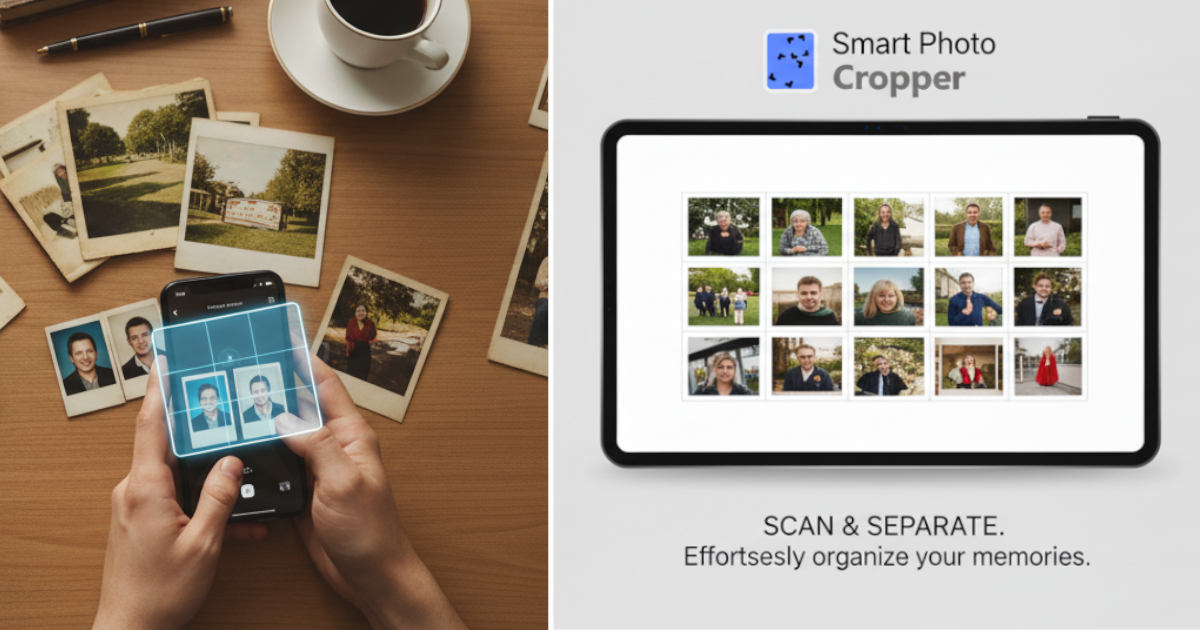
Standing in my flooded apartment, saving what I could, I realized the real enemy of preservation is friction. Whether you choose the high-end flatbed path or the smartphone path, the most painful, soul-crushing part of bulk digitization is the post-processing—the endless, repetitive clicking to crop, rotate, and straighten individual files.
I built SmartPhotoCropper.com to completely eliminate that bottleneck for both workflows. Instead of processing pictures one by one, the app lets you batch your work:
- If you’re using a flatbed scanner: Don’t waste your life scanning single prints. Fill the entire glass bed with 3 to 5 photos at once, leaving a small gap between them, and take one single high-resolution scan.
- If you’re using your smartphone: Lay out a group of photos neatly on a flat table under clean, even lighting, and take one clear shot containing all of them.
Once you upload that combined multi-photo file, the AI takes over. It automatically detects the boundaries of each individual photograph, separates them into distinct image files, removes perspective distortion, and rotates them so they sit perfectly upright.
Do you occasionally need to jump in and fine-tune a bounding box by hand? Sure—every now and then a faded edge or a decorative photo border needs a quick five-second adjustment. But in the vast majority of cases you don’t need to do any extra work at all. The AI does a genuinely great job right out of the box, which is exactly what makes batch photo scanning fast enough to actually finish.
A Quick Bulk-Scanning Workflow
If you want to start today, here’s the exact approach that finally got me unstuck:
- Grab one box. Don’t try to boil the ocean—commit to a single shoebox in one sitting.
- Lay out 3–5 prints on a flatbed scanner bed or a clean table, with small gaps between them.
- Capture once. One scan or one clear overhead phone photo per group.
- Upload the combined file and let the AI detect, crop, straighten, and split every photo automatically.
- Back up the results to two places—cloud storage and an external drive—before you touch the next box.
That’s it. No calibrated monitor, no research rabbit hole, no perfect setup required. You can digitize old family photos online for free and have a box done before your coffee gets cold.
Don’t Wait for the Unexpected
If my experience taught me anything, it’s that physical photo collections are fragile. A broken pipe, a basement leak, or a simple accidental spill can erase decades of history in minutes.
If you have the means to send your photos away, or the patience to spend weeks at a flatbed scanner, go for it—both are valid. But if you’re currently stuck in perfectionism paralysis, planning a massive project you never seem to start, stop waiting.
Grab a few boxes, lay out some photos, and back them up today. Your family history is defined by the faces, the moments, and the memories captured inside those frames—not by how expensive the equipment was that scanned them.
Get the data safe first. You can chase “perfect” later.
If this resonated, you might also enjoy Rediscovering Forgotten Memories: One Film Roll at a Time—another story about the treasures hiding in our old boxes.
Tags: #DigitizeOldPhotos #PhotoDigitization #ScanningTips #FamilyMemories #BulkScanning #FlatbedScanner #Productivity #PhotoBackup #MemoryPreservation